▌ PIXEL PISTOL™ FIELD NOTES
From Pixels to Production: How Pixel Pistol™ Creates Unique Sounds
Dive into Pixel Pistol™'s unique sound creation. Learn how any photo can become an 808, drum kit, or custom beat with our proprietary image-to-sound conversion tech. Transform cover art into signature audio.
From Pixels to Production: How Pixel Pistol™ Creates Unique Sounds
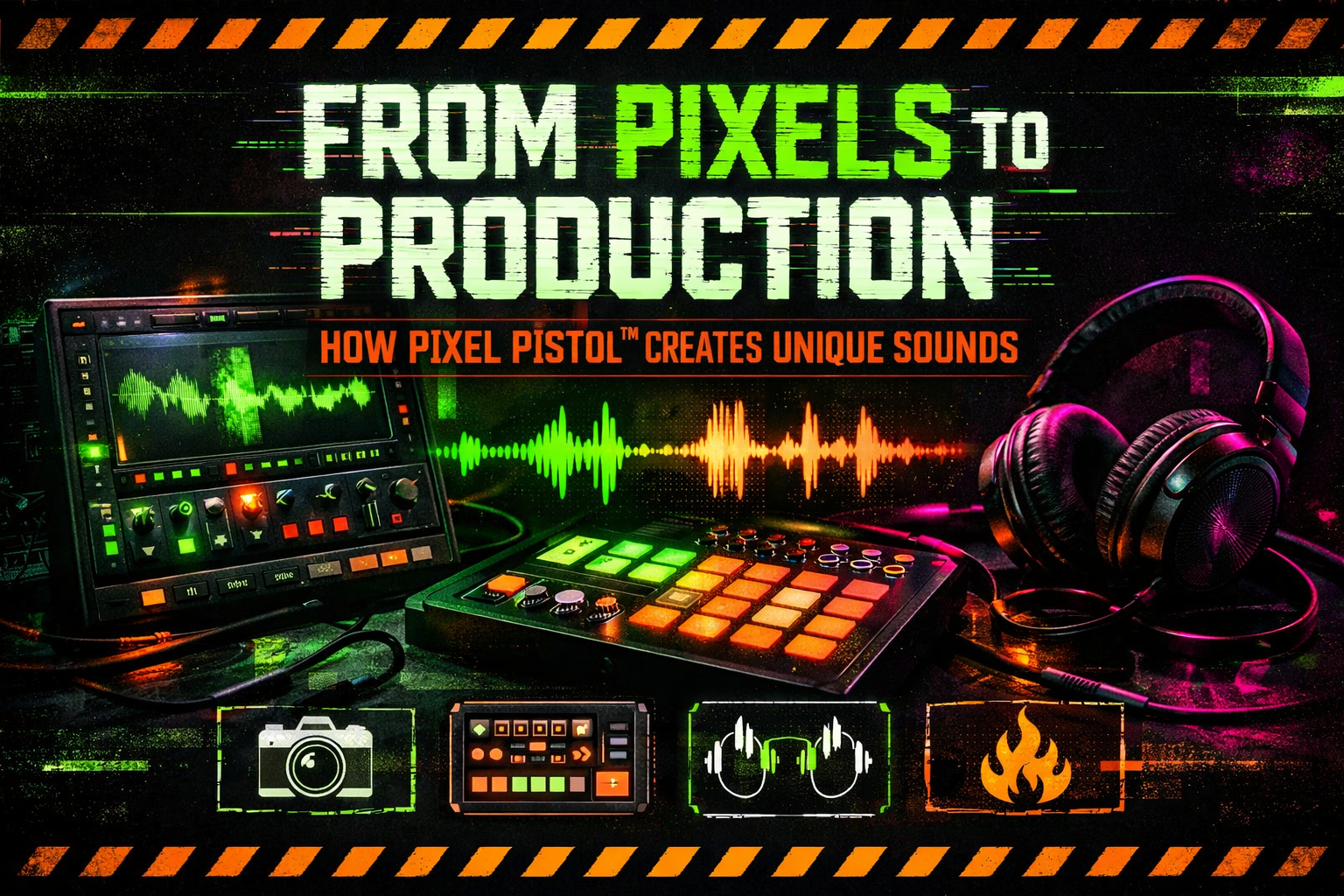
In the fast-evolving world of music production, the quest for unique, signature sounds is constant. Generic sample packs often lead to uninspired tracks, leaving producers longing for something genuinely fresh. What if every image you’ve ever captured, every piece of cover art, or even a random photograph held the secret to your next hit track? Imagine taking a photo and, with a click, transforming it into a booming 808, a crisp snare, or an entire custom drum kit. This is precisely the revolutionary power that Pixel Pistol™ brings to your studio.
Pixel Pistol™ is a groundbreaking browser-based creative audio tool developed by OHFIFTYB, designed to bridge the gap between visual artistry and sonic innovation. It allows music producers, beatmakers, and sound designers to convert any photograph into custom synth sounds and full producer-ready mini sample kits. No longer are you limited by predefined sounds; now, your visual inspiration directly fuels your sonic output. This article delves deep into the proprietary technology that makes this magic happen, exploring how Pixel Pistol™ transforms static images into dynamic, unique audio, from custom image to 808 to a complete photo to beat masterpiece.
We’ll unravel the core algorithms that underpin Pixel Pistol's unique sound generation, explain how diverse elements like drums, pads, and leads emerge from a single visual input, and demonstrate how specific pixel characteristics are meticulously mapped to create intricate waveforms. Get ready to understand the alchemy behind turning light and shadow into rhythm and melody, and discover how this tool can Revolutionize Your Workflow: Pixel Pistol™ for Modern Music Producers.
The Magic Behind the Music: Our Proprietary Algorithm
At the heart of Pixel Pistol™ lies a sophisticated, proprietary algorithm that deciphers the complex visual information within an image and translates it into nuanced audio parameters. This isn't just a simple conversion; it's an intelligent interpretation that extracts the 'sound DNA' from every pixel. The process begins with our innovative ImageWave™ technology, which serves as the foundational bridge between the visual and auditory worlds. Unlike other tools that might offer basic spectral analysis, ImageWave™ looks at an image as a rich dataset waiting to be sonified, moving far beyond mere pixel color to interpret luminance, contrast, texture, and spatial arrangement.
This deep analysis allows Pixel Pistol™ to generate sounds that truly embody the aesthetic and emotional qualities of the original image. A dark, moody photograph might yield a deep, resonant bass, while a bright, high-contrast image could spark a sharp, punchy drum sound. The algorithm dynamically adjusts various synthesis parameters – such as oscillation frequency, filter cutoffs, and envelope shapes – based on the visual data. This ensures that every sound generated is not only unique but also intrinsically linked to its visual source, offering an unparalleled level of creative synergy for sound designers and producers.
What is ImageWave™?
ImageWave™ is Pixel Pistol's cornerstone technology, acting as the primary interpreter between visual input and sonic output. When you upload a photo, ImageWave™ doesn't just read pixel colors; it performs a detailed analysis of image brightness across the entire visual spectrum. This brightness data is then meticulously mapped onto the waveform of a synthetic sound. Imagine scanning an image from left to right, and as the brightness changes, the amplitude or frequency of a sound wave fluctuates in response. That's a simplified view of ImageWave™ in action.
The result is a raw, organic waveform directly derived from your image's visual characteristics. A section of the image with a gradual brightness gradient might produce a smooth, evolving sound, while an abrupt change in luminosity could manifest as a sharp transient or a glitchy texture. This direct correlation ensures that the visual identity of your source image is imprinted onto the sonic character of the generated sound, providing a truly bespoke audio experience every time.
From Pixels to Parameters: The Data Conversion Process
The journey from a static pixel to a dynamic audio parameter is a complex dance of data translation. Pixel Pistol™ dissects an image into various data points: individual pixel values, average brightness of regions, color saturation, and even the detected edges and patterns. Each of these visual characteristics is then assigned to control a specific aspect of sound synthesis. For instance, the average brightness of a selected area might control the fundamental frequency of an oscillator, while the contrast ratio could dictate the resonance of a filter or the intensity of a modulator.
This multi-faceted mapping system ensures a rich, diverse sonic output. High saturation levels in a certain color might translate into a distinct timbre or harmonic content. The rough texture of a photographic element could influence the grain or bitcrush settings, adding a unique grit to the sound. This intelligent conversion process moves beyond simple one-to-one mapping, instead creating a complex interplay of visual data points that simultaneously sculpt multiple synthesis parameters. This allows for the creation of intricate, evolving sounds that possess the true essence of their visual origin, providing boundless opportunities to Unlock Untapped Creativity: Pixel Pistol™ for Experimental Sound Designers.
Crafting 808s, Drums, Pads, and Leads from Visuals
One of Pixel Pistol's most compelling features is its ability to generate a complete, producer-ready mini sample kit from a single image. This goes far beyond creating just one sound; it's about building an entire sonic ecosystem from your chosen visual. The Image Kit Generator™ is a testament to this, meticulously crafting 12 distinct types of sounds from one photo: the foundational ImageWave, a powerful Bass, a characteristic 808, a punchy Kick, a crisp Snare/Clap, a sharp HiHat, versatile Percussion, an atmospheric Pad, a melodic Lead, a dynamic Pluck, lush Strings, and an impactful FX Riser. This means your single image can become a comprehensive toolkit for your next production, offering everything from image to drums to full melodic elements.
The brilliance here lies in how the algorithm intelligently differentiates and processes the visual data to yield such diverse sonic outcomes. It's not simply applying the same visual-to-audio mapping to all 12 sounds. Instead, it utilizes different interpretive lenses for each sound type, focusing on specific visual characteristics that are most conducive to shaping that particular instrument. For example, elements in the image that lend themselves to low-frequency content and quick decay might be prioritized for the kick and 808, while areas with sustained visual information and complex textures could be used to generate rich pads or evolving strings.
The Image Kit Generator: A Sonic Palette
The Image Kit Generator™ is more than just a sound creator; it's a dynamic sonic palette that offers unparalleled creative freedom. When you upload an image, Pixel Pistol™ doesn't just give you a single sample. It analyzes the image's inherent visual qualities to construct a cohesive set of sounds that share a common visual 'DNA'. This ensures that all 12 sounds within your generated kit possess a unified aesthetic and character, making them effortlessly blend together in a track. Think of it as a musical fingerprint derived directly from your chosen visual, where every element, from the percussive attack to the ambient wash, speaks the same visual language.
This allows producers to quickly lay down entire beats and melodic foundations that are inherently unique and stylistically consistent. The generator’s intelligent design means you're not just getting random sounds; you're getting a curated selection that maximizes the musical potential of your image. This capability makes Pixel Pistol™ an essential tool for those looking to Pixel Pistol™: Transform Any Image into a Custom Producer Kit with unprecedented ease.
The Anatomy of a Visual-Generated Kit (808, Drums, Synths)
Let's break down how Pixel Pistol™ tailors specific sounds within the Image Kit Generator:
- 808 & Kick: For these low-end powerhouses, Pixel Pistol's algorithm often focuses on areas of high contrast, abrupt changes in brightness, or deep, uniform dark regions within the image. These visual cues are translated into powerful transients, sustained low frequencies, and rapid decay envelopes, crucial for punchy and resonant bass elements. The exact shape and duration of the 808's decay can be directly influenced by the subtle gradients or textures found in the source image.
- Snare/Clap & HiHat: Sharp, defined edges, granular textures, and distinct highlights in an image are typically channeled into percussive elements like snares and hi-hats. The algorithm leverages these visual characteristics to generate sharp attacks, metallic resonances, and short, crisp releases. A grainy photograph might yield a particularly "dirty" snare, while a precise, bright line could become a shimmering hi-hat.
- Pads & Strings: For atmospheric and sustained sounds, Pixel Pistol™ analyzes large areas of color, smooth gradients, and complex, interwoven textures. These visual properties are translated into slow attack and release envelopes, rich harmonic content, and evolving filter sweeps, creating lush, immersive pads and expressive string sounds that breathe with the visual's essence.
- Leads & Plucks: Bright, distinct shapes or patterns in an image often become the source for melodic leads and sharp plucks. The algorithm extracts these visual motifs and converts them into oscillating waveforms with defined pitches and varying envelopes, providing unique melodic voices that reflect the visual's contours. The specific frequency and timbre of a lead can be directly derived from the color and brightness curves of the image.
This intricate process ensures that every element of your kit is not only playable but also deeply infused with the visual soul of your chosen picture, giving you unparalleled control over the character of your photo to beat productions.
Understanding Pixel-to-Waveform Mapping
The core innovation of Pixel Pistol™ lies in its sophisticated pixel-to-waveform mapping. This isn't a simplistic conversion where one pixel equals one tiny blip of sound. Instead, it's a dynamic, multi-dimensional process where various attributes of pixels and pixel clusters influence the fundamental properties of a sound wave. Every aspect of an image – from the overall luminosity to the intricate patterns of light and shadow, the vibrancy of colors, and the density of textures – contributes to sculpting the final audio output.
For instance, the overall brightness of an image might determine the initial amplitude of a waveform, while the distribution of light across the image could influence its stereo spread. Areas of high contrast can lead to sharper, more aggressive sonic attacks, whereas smooth gradients might result in mellow, evolving tones. The specific hues and saturation levels of colors are often mapped to filter frequencies, resonance, or harmonic content, imbuing the sound with a distinct spectral character derived directly from the visual. This deep interaction means that two images, seemingly similar but with subtle differences in color or texture, will produce distinctly different, unique sounds.
Visual Traits and Their Sonic Equivalents
Understanding how specific visual traits translate into sonic characteristics is key to mastering Pixel Pistol™. Here's a breakdown:
- Brightness/Luminosity: This is perhaps the most fundamental mapping. High brightness often correlates with increased amplitude, leading to louder, more prominent sounds. Darker areas can result in lower amplitudes or even silence, creating dynamic range and rhythmic elements.
- Contrast: The starkness between light and dark areas in an image directly impacts the attack and decay of a sound. High contrast can create sharp, transient-rich sounds (perfect for drums), while low contrast might yield smoother, more sustained envelopes (ideal for pads).
- Color (Hue & Saturation): Colors are often mapped to the frequency spectrum and timbre. Warm colors (red, orange, yellow) might influence lower-mid to mid frequencies, adding warmth or aggression. Cool colors (blue, green, purple) could affect higher frequencies or resonant peaks, contributing to a sense of clarity or etherealness. Saturation can control the intensity of these spectral characteristics, or even modulate parameters like bitcrush or grain.
- Texture & Pattern: Intricate visual textures, such as wood grain, fabric weaves, or photographic noise, are excellent sources for granular synthesis or modulation. They can translate into effects like grain, bitcrush, stereo spread, or even subtle LFO movements, adding unique sonic grit, width, or evolving movement to the sound.
- Edges & Shapes: Defined edges and geometric shapes within an image can be used to generate distinct melodic contours or rhythmic gates, influencing the precise timing and pitch changes within a sound.
This comprehensive mapping creates a direct feedback loop between your visual inspiration and your sonic creation, making the process of sound design more intuitive and visually driven than ever before.
The Visual Oscillator™: See Your Sound Evolve
Pixel Pistol's Visual Oscillator™ takes the concept of pixel-to-waveform mapping a step further by offering a live, animated representation of your sound as it reacts to the input image. This isn't just an aesthetic flourish; it's a powerful visual feedback mechanism that demystifies the conversion process. As you adjust image parameters or even interact with the sound controls, you can literally see the waveform dynamically reshape itself, visually reflecting the subtle nuances that your image is imparting to the audio.
The Visual Oscillator™ displays the waveform that is being generated in real-time, its shape directly influenced by the brightness, contrast, and color data extracted from your uploaded photo. This interactive display allows producers to gain an immediate understanding of how visual changes translate into sonic alterations. Want a more aggressive sound? Watch how increasing the image's contrast makes the waveform sharper and more angular. Aiming for a smoother tone? Observe how a blur filter on your image mellows out the waveform's peaks and troughs. This visual insight empowers users to not only generate unique sounds but also to intuitively learn the intricate relationship between sight and sound, making the creative process more engaging and predictable.
Beyond the Basics: Generating Effects and Textures
While the core image-to-waveform mapping is foundational, Pixel Pistol™ truly excels by offering a robust suite of sound-shaping controls that elevate raw visual data into polished, production-ready audio. It's not enough to simply create a sound from an image; the ability to fine-tune, sculpt, and add expressive effects is what transforms a novel concept into a powerful production tool. Pixel Pistol™ integrates over 18 real sound-shaping controls, allowing you to manipulate every aspect of your generated sounds, creating complex textures and dynamic effects that go far beyond basic synthesis.
These controls include classic synth parameters like Attack, Decay, and Release (ADR) for shaping the sound's envelope, Octave for pitch manipulation, and Grain for adding subtle or aggressive textural elements. But it doesn't stop there. You can introduce digital distortion with Bitcrush, expand your soundscape with Stereo Spread, and add spatial depth with Reverb and Delay. Advanced modulation comes in the form of an LFO (Low-Frequency Oscillator), allowing for evolving movement and pulsating rhythms. This comprehensive array of tools ensures that the sounds generated from your images are not just unique, but also flexible and ready for integration into any mix, enabling you to Master Your Mix: Pixel Pistol™'s Powerful Output & Export Tools with ease.
Sculpting Sound with Advanced Controls
The real power of Pixel Pistol™ emerges when you start manipulating its extensive set of sound-shaping controls. These aren't just generic effects; they are deeply integrated into the visual-to-audio engine, allowing you to sculpt the image-derived sounds with precision and creative flair.
- Attack, Decay, Release (ADR): These envelope controls let you define how quickly a sound fades in, how long it sustains, and how it fades out. A fast attack paired with a punchy image might create a sharp drum hit, while a slow attack and long release can transform a visual into an evolving pad.
- Octave: Shift the pitch up or down to find the perfect register for your image-derived sound, whether it's a subterranean image to 808 or a sparkling lead synth.
- Grain: This control introduces tiny audio particles, allowing you to add subtle texture or aggressive, glitchy character. An image with fine details or noise might interact beautifully with the grain parameter.
- Bitcrush: Reduce the bit depth of the audio for lo-fi, digital distortion effects, perfect for gritty, industrial, or retro vibes.
- Stereo Spread: Expand your sound across the stereo field, adding width and spatial presence to your image-generated sounds.
- Reverb & Delay: Apply these essential spatial effects to place your sounds in various acoustic environments, from intimate chambers to vast halls, adding depth and atmosphere.
- LFO (Low-Frequency Oscillator): Introduce rhythmic or evolving modulation to almost any parameter, such as pitch, filter cutoff, or amplitude. An LFO can breathe life into a static sound, making it pulsate, wobble, or sweep over time, adding a dynamic layer that mirrors complex visual movements.
These controls work in harmony with the initial visual mapping, providing an endless canvas for experimentation. You're not just getting a sound; you're getting a highly malleable instrument whose DNA is intrinsically linked to your visual input.
From Raw Data to Polished Production
The journey from a raw image file to a polished, producer-ready sound kit with Pixel Pistol™ is streamlined for efficiency. After you've utilized the ImageWave™ and Visual Oscillator™ to generate your initial sounds and sculpted them with the extensive sound-shaping controls, the next crucial step is getting those sounds into your DAW. Pixel Pistol™ offers direct WAV export for individual sounds, ensuring high-fidelity audio that integrates seamlessly into any production environment.
Furthermore, the Image Kit Generator™ allows you to export your entire 12-sound kit as a convenient Sound Pack ZIP file. This means you can create a complete drum kit, melodic elements, and effects, all derived from a single image, and have them organized and ready for use in seconds. Each kit also comes with a unique Sound Receipt™ – a digital certificate that confirms the image source and the exact parameters used to create the sounds, ensuring authenticity and providing a creative blueprint for future iterations. This commitment to robust export features underlines Pixel Pistol's dedication to being a genuine tool for professional producers and sound designers, transforming creative concepts into tangible, high-quality audio assets for any cover art to sound project.
FAQ
Q: What kind of images work best with Pixel Pistol™?
A: Any image can generate unique sounds! However, images with varied brightness, strong contrasts, distinct colors, and interesting textures tend to yield the most diverse and interesting sonic results. Experimentation is key!
Q: Can I use Pixel Pistol™ to create entire songs?
A: Pixel Pistol™ is a powerful sample and synth sound generator. It provides the building blocks – unique 808s, drums, pads, leads, and FX – that you then arrange and compose into full songs within your Digital Audio Workstation (DAW). It's designed to provide an endless source of fresh sounds for your productions.
Q: How does Pixel Pistol™ ensure the sounds are truly unique?
A: Because each image contains a unique arrangement of pixels, brightness values, and colors, every sound generated by Pixel Pistol™ is inherently one-of-a-kind. Our proprietary ImageWave™ algorithm maps these specific visual characteristics directly to audio parameters, ensuring that even slightly different images produce distinct sonic outcomes.
Q: Is Pixel Pistol™ suitable for beginners or only advanced producers?
A: Pixel Pistol™ is designed to be intuitive for all levels. Beginners can easily upload an image and instantly get a unique sound kit, while advanced producers can dive deep into the 18+ sound-shaping controls for intricate sound design. Its browser-based nature also makes it highly accessible for anyone looking for a Browser Beat Maker Redefined: Intuitive Production with Pixel Pistol™.
Conclusion
Pixel Pistol™ stands as a revolutionary leap in creative audio technology, fundamentally changing how producers and sound designers source and sculpt their sounds. By transforming any image into a vibrant sonic landscape, from a thumping image to 808 to an entire custom drum kit, it unlocks an unprecedented wellspring of unique audio possibilities. Our proprietary ImageWave™ technology and advanced pixel-to-waveform mapping ensure that every generated sound carries the distinct "DNA" of its visual origin, making your productions truly one-of-a-kind.
The power to craft 12 distinct instrument types from a single photo, combined with a comprehensive suite of 18+ sound-shaping controls, means you're not just creating sounds; you're designing entire sonic experiences deeply intertwined with your visual inspiration. Whether you're a hip-hop producer seeking a signature photo to beat, an electronic artist looking for experimental textures, or a sound designer aiming for truly unique audio assets, Pixel Pistol™ equips you with the tools to push creative boundaries. Stop digging through endless, generic sample packs and start firing your own unique sounds.
The future of sound design is visual, and Pixel Pistol™ is leading the charge. Ready to transform your visual world into an unparalleled sonic arsenal? Start Your Sonic Journey: Get Pixel Pistol™ Founder Lifetime Access Today and experience the future of sound generation.
▌ READY TO FIRE YOUR OWN?
Stop digging. Fire your own.
Turn one image into a custom producer kit: 808s, drums, pads, leads, FX, and WAV exports.
Already making music? Check out TrapFlip.com and SongSteward.com.